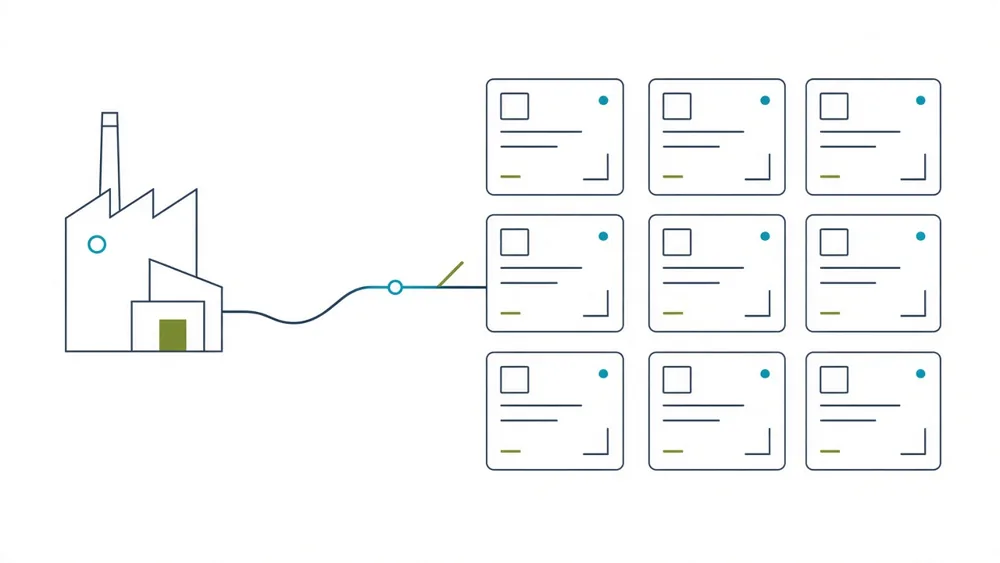
Four patterns, and you will recognise at least two.
These are category truths rather than one company's story. None of them names a customer, because
none of them needs to.
The spreadsheet in the middle.
Information leaves one system as a document, gets modified by a person, and is retyped into the
next one. Word documents and PDFs transferred into a spreadsheet so the spreadsheet can be
manipulated into a load file. Nutrition panels copied by hand out of a formulation system and into
a document to build a spec sheet. It works, right up until the person doing it takes a week
off.
The data that lives with the supplier.
The specification data you need to run the business is held by your suppliers, arrives as an
email attachment, and the internal answer is a person chasing documents. Nobody can say what is
still outstanding without asking around.
The approval chain that runs on memory.
Somebody creates a spec, attaches the drawing, and then becomes the first approver because that
is how it has always worked. The sequence exists as folklore rather than as workflow, and it is
different for packaging, ingredients, artwork and finished goods.
The record opened under pressure and never closed.
A quality non-conformance is opened on the line with the product code blank and the units held
unrecorded, and there is no closure loop. It becomes an audit finding months later.
The stack
The systems this work actually runs on.
This buyer identifies by stack, so the stack comes first. Nothing here asks you to move.
Specification and product data platforms built on Salesforce.
Including Specright. If it is built on the Salesforce platform, we already administer platforms
like it: sandboxes and partial copy refreshes, permission sets and permission set groups, record
types, page layouts, flows, Apex, SOQL, Data Loader and deployment tooling are our daily working
vocabulary, at scale, in large mature orgs.
Enterprise resource planning.
SAP, including S/4HANA, and NetSuite. Integration between the resource planning system and the
specification system is the single most requested piece of work in this sector, because its
absence is what forces the manual step.
Formulation, nutrition and regulatory systems.
Nutrition and formulation databases, regulatory ingredient data providers, plant floor quality
systems and scheduling systems.
Packaging analysis and document generation.
Packaging analysis software with bidirectional XML transfer, and document generation for
specification and dossier export.
Supplier portals and data lakes.
Portal entitlement management, supplier document collection, and REST interfaces over a
corporate data lake.
Documents, email and meetings.
SharePoint, OneDrive, Google Drive, Microsoft 365 and Google Workspace, plus meeting
transcription, so the decision made in a Tuesday call is searchable next to the specification it
was about. Anything else with a documented API is quotable work.
Five sectors, one operating problem. The figures below are published market and regulatory data,
not client data.
Food and beverage manufacturing and food processing.
Formula versions, allergen matrices, label copy, supplier certificates of analysis, and a
recall clock. In 2025 the FDA and USDA issued 320 US food recalls and undeclared allergens were
the single largest cause at 38.8%. The FSMA 204 Food Traceability Rule compliance date is now 20
July 2028, which is enough time to do this properly and not enough to do it twice.
Consumer products and personal care.
Specification dossier assembly is a document problem wearing a data problem's clothes. Somebody
downloads each specification individually and reassembles them into a dossier, and when that
somebody leaves, the capability leaves with them. 71% of consumer goods leaders report adopting AI
in at least one function, up from 42% the year before, which means the question in this sector is
no longer whether to use it.
Industrial and building products.
Specification data held by suppliers, approval chains that exist as habit, and large mature
platform orgs at their limits. 79% of manufacturers are investing in or exploring AI in 2026, up
from 64% in 2025, yet only 7% define configuration rules once and reuse them across systems. That
gap is the work.
Retail own brand.
Own brand is where a retailer takes on manufacturer style specification obligations without
manufacturer style systems. Supplier data arrives offline, on a form, with no approval gate and no
way to see what is outstanding. US store brand sales reached a record $282.8 billion in 2025 at
21.3% dollar share and 23.5% unit share, both all time highs, so this is now a first class
operation rather than a side line.
Agriculture and fresh produce.
Compliance heavy, seasonal, and run by teams that are thin by design. Approval workflows differ
by object type, and a process stops when the person who knows it is in the field. The argument
here is continuity when the team is stretched, not headcount reduction.
Logistics and foodservice supply.
Specification and supplier data work for quick service restaurant supply, where the same seams
appear between the specification platform, the resource planning system and the supplier's own
document set.
Pack 3
Product and Manufacturing Operations.
The pack composes onto the whole ground, the whole spine and six jobs. The baseline underneath it
is live in production today. The industry specific part is a first customer build, and the two are
badged separately below so nobody has to guess.
Shipped Live today, running for a real customer on real data
First customer build The baseline exists; the industry specific part would be built with you
What the baseline already does with your data
Live in production
Every document, every page
Certificates of analysis, supplier specifications, artwork proofs, regulatory dossiers,
quality records and the scanned pages inside them. Opened page by page, indexed, summarised and
citable to the page.
Shipped
Search inside the contents
Ask which items reference a material, a supplier, an additive or a claim, and get an answer
across the whole book rather than one file at a time.
Shipped
A mirror in your own database
Every object copied into a database that belongs to your tenant alone, with count parity
verified against the source, refreshed continuously, and nothing ever deleted from the
mirror.
Shipped
What is outstanding, without asking around
Records opened with mandatory fields blank. Documents still being chased from a vendor.
Approvals sitting in somebody's memory rather than in a queue. Surfaced on the record header
rather than found in an audit.
Partial
Email and meetings alongside the record
Because in this sector the specification change is agreed in a call and confirmed in an email
thread, and only then does anyone update the system.
Partial
Nothing writes back without approval
Every write into a source system is staged, whitelisted and approved by a person, and it
enforces the calling user's own permissions in that system.
Shipped
What a manufacturing pack would add
Pack 3, first customer build
First customer build
Read across the seams
Objective. Put one governed layer over specification, supplier, quality and
correspondence data that currently only meets inside a spreadsheet.
The mirror copies the specification and product records into the customer's own database. The
document layer reads every attachment page by page. The assistant answers across all of it and
cites the page. Nothing moves and no system is replaced.
Requirement: a national food and beverage manufacturer, a direct client,
where thirty-two systems held the data and none of them were talking to one another.
First customer build
Assemble the dossier instead of downloading it one specification at a time
Objective. Produce the technical dossier, the specification sheet and the bill of
materials report deterministically from the systems that hold the parts.
The assembler builds the document from the specification records, the supplier documents and
the customer's own template, with the source and page behind each element and an approval before
it leaves. The capability that currently lives in one person's routine becomes a procedure that
survives their departure.
Requirement: a pattern named repeatedly across consumer products and
personal care specification work. The assembly capability is ours regardless of who the
contracting party on any given engagement is.
First customer build
The outstanding items queue
Objective. Make the chase list a queue the system maintains rather than a question
people ask each other.
Every record where an expected document has not arrived, an approval has not moved, or a
mandatory field was left blank at the moment of opening, surfaced continuously and sorted by
age. No model call, so it costs nothing to run.
Requirement: a category pattern across building products and food
manufacturing, where documents are still being chased from vendors and non conformance records
recur with mandatory fields blank and no closure.
First customer build
The approval chain, written down
Objective. Turn a sequence that exists as folklore into a procedure with the decision
points marked.
The system reads how the approval actually runs from the record and correspondence trail,
writes it as a runnable procedure, and executes the deterministic parts. Judgement steps route
to the responsible person.
Requirement: a category pattern in discrete manufacturing, where the person
who creates a specification and attaches the drawing then becomes the first approver because
that is how it has always worked.
2026 context
Regulation is doing the selling this year.
Six US states hit their packaging extended producer responsibility reporting deadline on 31 May
2026, with California, Colorado and Oregon requiring SKU level and component level packaging data.
The EU Packaging and Packaging Waste Regulation applies from 12 August 2026. Neither of those is
satisfiable from a spreadsheet and an email thread. Both of them are satisfiable from a
specification platform that is complete, current and queryable, which is a different problem from
the one most teams are staffed for.
We are not a compliance product and we will not claim to be one. What we do is close the gap
between what the platform says and what is actually true, which is the part that makes a submission
defensible.
What this pack does not do
What is ours, and what is a capability claim.
Saying this on the page that is meant to open a new market is deliberate. Do not imply a pack
exists.
There is no manufacturing pack. The baseline platform is what exists today and it is
industry neutral by construction: the mirror, the document layer, the permission model, the audit
log, the cost meter and the assistant do not care what business you are in. The industry specific
objects, roles and rules would be built with you as the first customer, which is a different
conversation and a different price.
We will not dress up a partner's client as ours. A large part of the specification
and product data work in this sector reaches us through partners, where the partner is the
contracting party. That work is not on this page as proof.
It is not a compliance product. Extended producer responsibility, packaging waste and
traceability submissions are prepared by your people. What we do is make the underlying data
complete, current and queryable.
It does not build you a presentation. Word, Excel, PDF and assembled packets, yes.
PowerPoint, no. It also does not read handwriting, does not send anything on its own, and does not
make phone calls.
Direct client relationships. We hold direct relationships in food and beverage
manufacturing, personal care, oral and pet care, regulatory ingredients data, fruit genetics and
licensing, and fresh produce. Those are our clients, contracted with us.
Platform depth is ours regardless. What is ours either way is the platform capability:
administering large mature Salesforce based product data orgs, integrating them with enterprise
resource planning systems, building supplier portals and data lake interfaces, and running the
deployment discipline that keeps them stable.
What is live in Mayeshal today. The baseline platform: the mirror, the document layer,
search, citations, the assistant, the audit log, the cost meter and the approval gates. That is
running in production now.
Get started
See it read one of your own matters.
Thirty minutes, on a screen share, on a matter you pick. We connect nothing, install nothing
and ask for no credentials to have that conversation. If it is not obviously useful in the first
ten minutes, we will tell you so and you get your afternoon back.