The document store behind your platform.
Every attachment in every file, read page by page rather than sampled. At one customer that is 44,956 documents and 127 GB, and coverage is 100% of everything the document system will actually serve.
Every claim Mayeshal makes names the document and the page it came from, and the link opens that file at that page. This is the feature a firm asked for by describing its absence: their own words for the problem were that the AI could not point at the page it got an answer from.
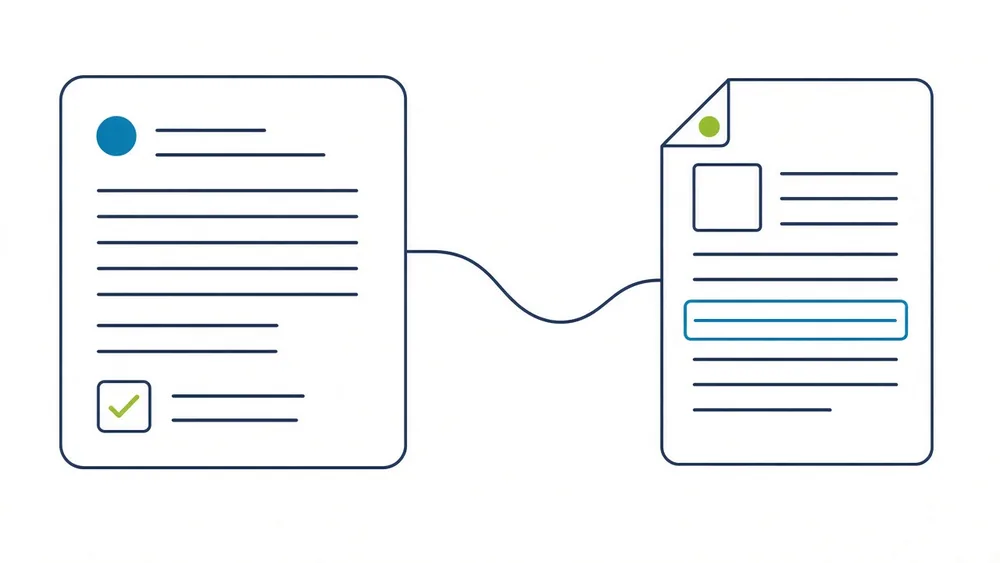
A general assistant will give you a fluent answer about a file it has read a fragment of, and the answer will be right often enough that people stop checking. That is the dangerous state. The first time it is wrong in a way that matters, nobody can reconstruct where the sentence came from, because there is nothing to reconstruct.
In a regulated business the requirement is stronger than accuracy. You have to be able to show where an answer came from, months later, to someone who was not in the room. Across five separate products there is no single trail to follow, and inside a product with no citation there is no trail at all.
So the design rule here is blunt. If the pages do not support the sentence, the sentence does not get written.
Citation is not a formatting step at the end. It is a property of how the corpus was built in the first place.
A text layer where there is one, optical character recognition where there is not, and a vision model for photographs and screenshots. The status of every page records how it was read, so a recovered rendering is never mistaken for the original.
A citation returns the file, page N of M, and the matching passage itself. You are not trusting a summary of a summary, you are looking at the sentence the model looked at.
Clicking a citation opens the document at the cited page rather than at page one of a nine thousand page binder. On one live matter a phrase search returned twelve page level hits across 9,339 pages.
Where the pages do not support a conclusion, the tool says so and names what is missing. The instruction it runs under is explicit about not filling the gap from memory.
Citations are only as good as the corpus underneath them, so the corpus is the product.
Every attachment in every file, read page by page rather than sampled. At one customer that is 44,956 documents and 127 GB, and coverage is 100% of everything the document system will actually serve.
Once a document has been read, a copy sits in your tenant's own storage. Opening it takes hundredths of a second, and more usefully it still opens when the source system is throttled.
A citation is more useful when the system also knows whose file the page belongs to, which is what the mirror of your records is for.
Threads and transcripts become citable objects alongside documents. These connectors are authorised in your own tenant during implementation.
The industries where a cited page is not a nicety, and the ones where it quietly saves an afternoon.
Records, deadlines, negotiations and the document file never sit in one place, and the client is asking one question about all of it.
Legal pack, live in productionClient records, a books and records obligation, and an examiner who wants to see what you knew and when.
Pack built and signedClient documents arriving as PDFs and email, and a person moving them into a spreadsheet by hand.
First customer buildA citation points at your own documents. It is not a legal authority and it is not a published source. Case law search and citation verification against published authority is a separate capability with its own page.
A page that cannot be read confidently is flagged rather than guessed at, and the page status records how it was read. That is deliberate: a confident wrong reading inside a client file is worse than a plain statement that a person needs to look.
And it does not follow that every question has an answer in the file. Often the correct output is that the record does not support the conclusion and here is the document that would. That is the system working, not failing.
Thirty minutes, on a screen share, on a matter you pick. We connect nothing, install nothing and ask for no credentials to have that conversation. If it is not obviously useful in the first ten minutes, we will tell you so and you get your afternoon back.