Industries

Same platform. Different applications on top.

Mayeshal is not built on any one platform, and it was not built for any one industry. The team behind it runs specification and product data platforms at manufacturers, case management platforms at law firms, lending and advisory systems at financial institutions, and a tax practice's whole operation, all on the same underlying platform work. That is why the connector conversation here is short.

One control plane, four industry pages Depth stated per industry, not averaged Your AI keys, 0% markup
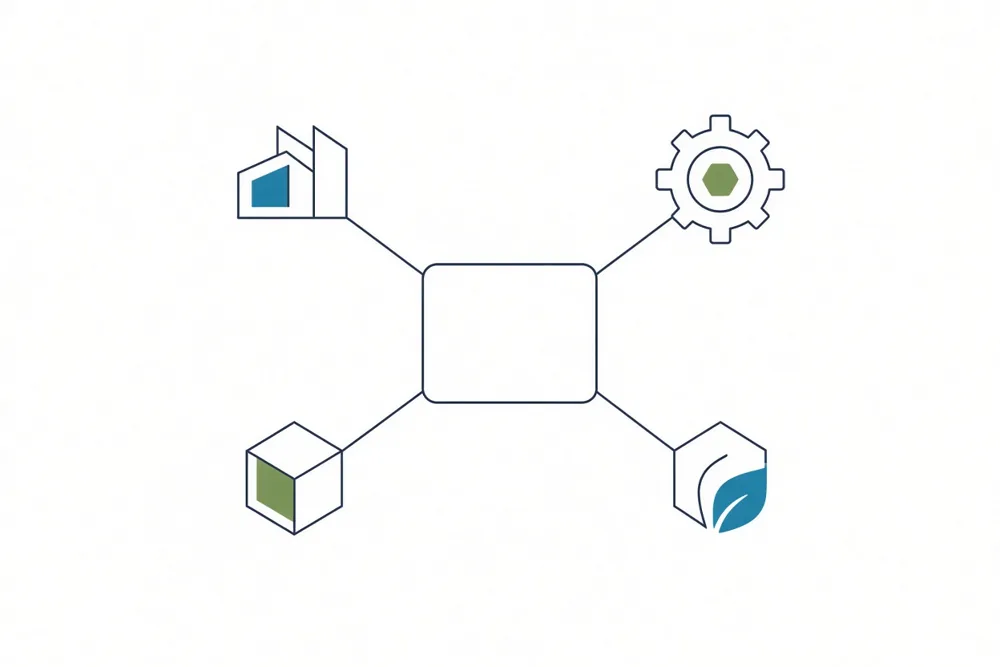
Line illustration of four industry symbols, a factory building, a gear, a shipping carton and a leaf, each joined by a short line to a single rounded square at the centre.
The mechanism

Breadth is architecture, not a logo wall.

The reason a business should care that we work across industries is not credibility theatre. It is that the failure mode is identical everywhere. A company has enough systems. What it does not have is one that can read across them, and the seams between them are staffed by people retyping from one screen into another. A food manufacturer copies a nutrition panel out of one system and into a document to build a spec sheet. An advisory firm copies email correspondence into a client feed for the record. A tax practice sends reminders by hand because the batch process cannot send a text message. A law firm's records arrive as a photograph of a screen. Different vocabulary, same seam.

An AI operations layer earns its place by reading across the seams. Every industry below is the same product doing the same thing against a different stack.

The shared capability model, in one paragraph. Underneath every industry page on this site is one model in three floors with a spine running through it. The ground is what the platform builds before it answers anything: it connects the systems you already run, mirrors your records into a database that belongs to your tenant alone, never erases what changed, opens every document page by page, summarises each one and works out how your records actually relate. On top of that sit six jobs people do: ask across everything at once, get the page an answer came from, assemble a document from many systems, find what is missing or overdue, prepare a person for what is next, and send only after a person approves. The industry pack is the third floor, and it is the only part that changes between the pages below. The spine, permission, audit, cost meter, approval gate and a defined exit, applies on every request across all three floors without exception.

See the three floors and the spine in full

Honest depth

What each of those four signals actually means.

A depth signal is worth nothing if it is not spelled out. Here is the long version of each one, including the parts that do not flatter us.

Legal. Live in production.

Nineteen firms, direct relationships, the deepest capability set in the product, and the only vertical pack running in production today. Plaintiff personal injury on Litify is where it is deepest. In this sector since 2019, with a published client testimonial.

What that does not mean: the personal injury pack is not a pack for every practice area. The baseline platform works against any matter type. The medical records work, the treatment timeline and the demand engine are personal injury specific.

See the legal page

Financial services. Pack signed.

Wealth and retirement advisory, agricultural and commercial lending, real estate and private lending. Two Farm Credit System institutions is a credential very few implementation firms hold. Direct client relationships across all of it.

What that does not mean: the advisory pack is built, signed, published and its dry run install passes end to end, and it has never run for a customer. There is no production advisory tenant. Lending is a first customer build on the same baseline.

See the financial services page

Product and manufacturing. First customer.

Direct client relationships in food and beverage manufacturing, personal care, oral and pet care, regulatory ingredients data, fruit genetics and licensing, and fresh produce. This is where the platform depth is widest: administering large, mature Salesforce based product data orgs, integrating them with enterprise resource planning systems, building supplier portals and data lake interfaces, and running the deployment discipline that keeps them stable.

What that does not mean: there is no manufacturing vertical pack today. The baseline is what exists, and the industry specific objects, roles and rules would be built with you as the first customer.

See the manufacturing page

Accounting and tax. First customer.

One relationship, three years deep, a named client and a published testimonial. AccuFirst and TaxFirm.com have been a Micronetbd client for over three years and we run their operations platform every day.

What that does not mean: one client is depth, not breadth, and we are not going to write a plural claim. There is no accounting vertical pack. The pack would be built with you as the first customer.

See the accounting page

No page, but real

Four more, stated plainly.

These did not earn a page. That is a statement about what we are prepared to put on an industry page, not about whether the work is real.

Software and communications.

Business messaging platforms, fraud prevention and IP intelligence, legal client communication software, media software. Revenue operations, message queue and middleware engineering, duplicate management at fifteen thousand records, quote and approval workflow, and document generation through DocuSign and PandaDoc.

Real work with real depth. It does not get a page because the most interesting piece of it is in progress rather than delivered, and we do not put in progress work on an industry page.

Contact centre and telephony operations.

NICE CXone, RingCentral, Dialpad, CallRail and Genesys. Outbound dialer campaign builds, agent and skill status, dispositions, call lists and interactive voice response paths, running today alongside case management systems.

This is a capability that appears inside other industries rather than an industry of its own, and the campaign build work is a Micronetbd implementation service rather than a Mayeshal feature.

How the integration works

Real estate and private lending.

Escrow automation with multi entity invoicing, commission automation across markets and agent types, document automation, and a new business line stood up end to end inside an existing shared platform. Covered as a section inside financial services.

See financial services

Logistics and foodservice supply chain.

Specification and supplier data work for quick service restaurant supply. Covered as a sector inside product and manufacturing operations.

See product and manufacturing

First party data

Requirements do not fail in engineering.

We instrument our own delivery the same way the product instruments a customer's. Across our own delivery record we tracked 1,119 requirements end to end, from the moment each one was raised to the moment it was resolved.

1,119
Requirements tracked end to end across our own delivery
585
Raised in an email thread
534
Raised in a meeting
4 of 4
Leading failure modes are not technical: missing discovery, documentation gaps, unclear requirements, communication breakdown

These numbers describe our own delivery record, not a customer performance statistic. We publish them because they are first party and checkable, not because they flatter us.

Requirements arrive almost equally by email and by meeting. Any AI layer that reads only one of those is reading half of what a business decides.

The top failure modes are not technical. Missing discovery, documentation gaps, unclear requirements and communication breakdown lead the list by a wide margin, ahead of testing gaps, environment issues and integration mismatches. Work does not usually fail because somebody built it wrong. It fails because the thing that should have been written down was not.

That is the surface an AI operations layer covers, and it is why this product reads email and meetings alongside records and documents rather than treating them as an afterthought.

The honest version

Then you would be the first, and we would say so.

The baseline platform is industry neutral: the mirror, the document layer, the permission model, the audit log, the cost meter and the assistant do not care what business you are in. What is industry specific is the pack, and today there are two of them.

Building a pack with you as the first customer is a real option and we have done it twice. It is a different conversation and a different price, and pretending otherwise would waste your quarter. Bring the stack list and the two or three things that are actually costing you time, and we will tell you honestly whether the baseline alone gets you most of the way there.

Get started

See it read one of your own matters.

Thirty minutes, on a screen share, on a matter you pick. We connect nothing, install nothing and ask for no credentials to have that conversation. If it is not obviously useful in the first ten minutes, we will tell you so and you get your afternoon back.