The document store behind your platform.
Every attachment in every file. At one live customer that is 44,956 documents and 127 GB, and coverage is 100% of everything the document system will actually serve.
A large part of any real file is not a clean PDF. It is a crooked scan, a fax of a fax, a photograph of a screen, a chart note somebody wrote by hand. Mayeshal treats those as readable, at production volume, and records on every page how it was read so nobody mistakes a recovered rendering for the original.
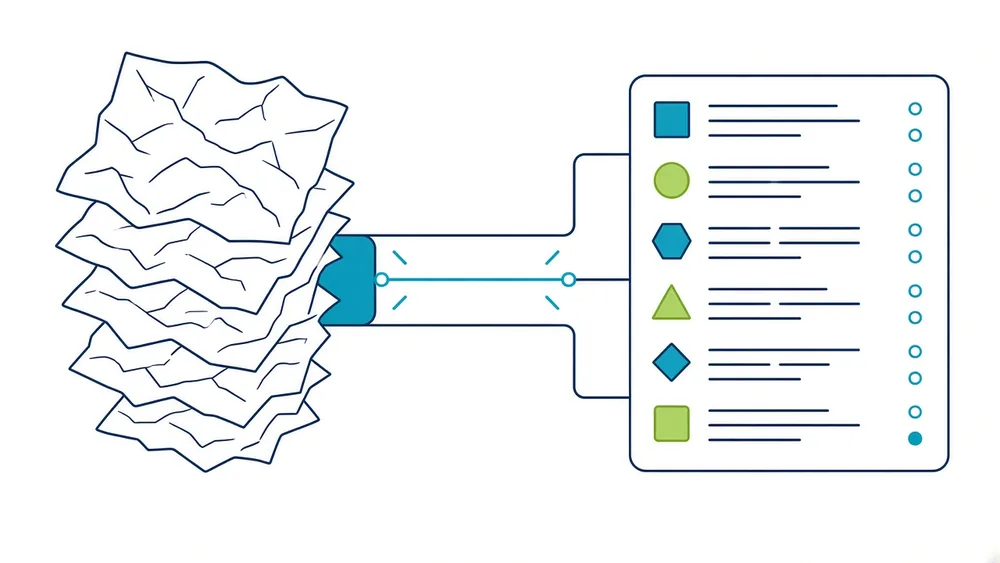
The documents that matter most are usually the worst quality ones. Records arrive scanned crooked, reports arrive as photographs of a screen, forms arrive as faxes, and the note that changes the answer was written by hand in a margin. A system that silently skips those is not reading the file, it is reading the easy part of the file and answering as though it read all of it.
Silence is the specific danger. If a page cannot be read and nothing says so, every downstream answer is quietly built on a gap, and nobody knows which gap. The fix is not only better reading, it is recording what happened to every single page.
Volume is the other half. Reading one binder on demand is a demo. Reading a hundred and twenty seven gigabytes of records and keeping up as more arrive is an operation, and it has to cost something a business can actually absorb.
Four passes, in order, with a status written for every page so the gaps are visible instead of invisible.
Delivered in your implementation
If a document already carries text, that text is used. It is faster, it is exact, and it costs nothing, which matters when the corpus is measured in hundreds of thousands of pages.
Optical character recognition runs on our own hardware, which is why the per page cost is zero rather than a line on a bill. A measured pass runs at under three seconds a page, and a page that will not render is recovered rather than abandoned.
Handwritten pages and photographs are read rather than dropped, and where a passage cannot be read with confidence it is marked for a person instead of guessed at. A confident wrong reading of a chart note is worse than a page that says a human should look.
Every page is searchable and citable, and every page carries the status of how it was read. That status is the honesty mechanism: nothing is silently skipped, and a recovered rendering is never presented as the original.
This is the floor the rest of the product stands on, which is why it is worth doing properly once.
Every attachment in every file. At one live customer that is 44,956 documents and 127 GB, and coverage is 100% of everything the document system will actually serve.
A copy of every document read is held in your own storage, so a file already read opens in hundredths of a second and still opens when the source system is throttled or down.
Indexed pages are what make a cited page possible. The two capabilities are the same corpus seen from two ends.
Every document is summarised once, which is why a question across a whole book of business is affordable rather than theoretical.
Medical records, supplier certificates, client tax documents, plant floor forms. The formats differ. The problem does not.
Records, deadlines, negotiations and the document file never sit in one place, and the client is asking one question about all of it.
Legal pack, live in productionSpecification, supplier and quality data spread across systems that were never introduced to each other.
First customer buildClient documents arriving as PDFs and email, and a person moving them into a spreadsheet by hand.
First customer buildA page that cannot be read with confidence is flagged for a person rather than guessed at, and the page status says so. That is a deliberate refusal, not a shortfall, and it is the reason the rest of the corpus can be trusted.
Reading a page is not interpreting it. A vision pass describes what is visible and stops there. It does not assign fault, infer causation, rate severity or name a person from a face. Those are human calls and a confident wrong answer in a client file is worse than no answer.
Production volume as a standing service arrives inside your implementation rather than on the day you sign, and it lands within the ninety day window. Typed text on scanned pages and photographs are read today, an hourly catch up keeps the corpus current, and the numbers on this page are from a live production corpus rather than a projection.
Thirty minutes, on a screen share, on a matter you pick. We connect nothing, install nothing and ask for no credentials to have that conversation. If it is not obviously useful in the first ten minutes, we will tell you so and you get your afternoon back.