Your mail infrastructure.
Microsoft 365 or Google Workspace, with your own sending identity, so the send is on your record and inside your own retention posture rather than a vendor one.
A finished document sitting in a drafts folder has produced no value at all. Outbound dispatch takes the approved letter, demand, notice or packet and delivers it through your own system, so the send is logged against your record rather than inside a vendor tool nobody will look at in two years.
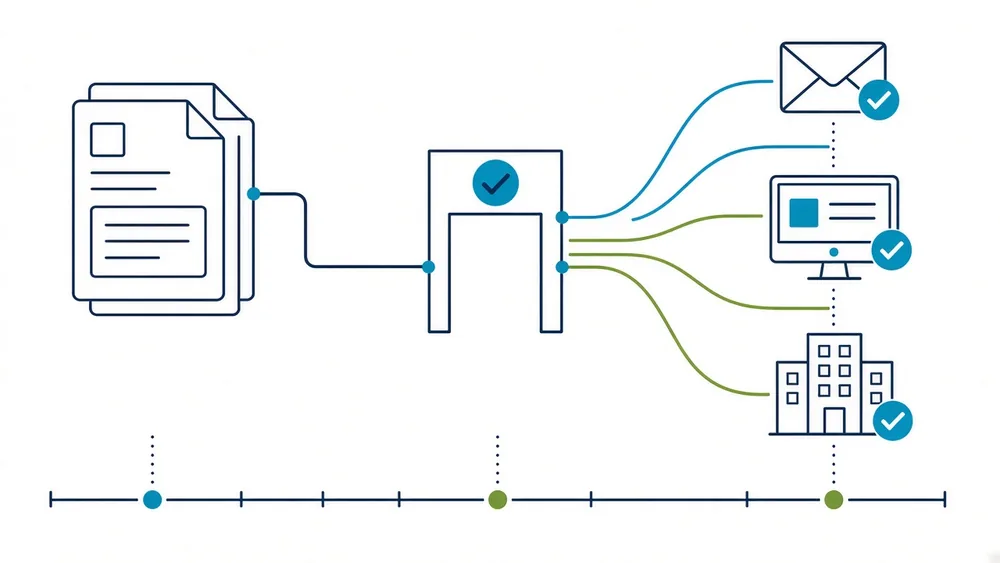
Assembly is the part that looks hard and the last mile is the part that costs. Somebody downloads the packet, opens the mail client, finds the right recipient, attaches the file, writes the covering line, sends it, then goes back into the record system and types a note saying they did. Repeat that forty times a week and it is a job.
The failure mode is not that it takes ten minutes. It is that the note sometimes does not get typed, so the record says the letter was never sent, and three months later nobody can prove otherwise. The document is fine. The trail has a hole in it.
The design decision that follows is the important one. Dispatch goes out through your own system rather than ours, precisely so the record of the send lives where your people and your auditors already look.
Delivery is the last step and it is never the first unattended one.
Delivered in your implementation
Nothing is queued for delivery that a named person has not approved. Approval is a human act with a timestamp against a specific version of the artefact, and it is the same gate that stands in front of every write back.
The contamination check runs on approval, on packet generation and once more at hand over, and it fails closed. A document naming an identifier from another client's file is refused at every gate, with the category and the source named in the error.
Delivery uses your own mail infrastructure and your own sending identity, so the recipient sees your organisation and your systems see the send. We are not a sending domain sitting between you and your counterparties.
What went out, to whom, when, and which version, written back against the record through the same staged and whitelisted path as every other write.
Nothing here asks you to change how your organisation communicates. It asks to be allowed to use it.
Microsoft 365 or Google Workspace, with your own sending identity, so the send is on your record and inside your own retention posture rather than a vendor one.
The dispatch event, the recipient, the timestamp and the version are staged back onto the record and approved, so the trail is in the system your people already open.
The same gate, the same contamination check and the same audit trail that guard every other action. Dispatch does not get a private path.
The packet that gets delivered is the one built deterministically from your records, your documents and your own templates.
Different recipients, same last mile: an approved document that has to leave and be proven to have left.
Records, deadlines, negotiations and the document file never sit in one place, and the client is asking one question about all of it.
Legal pack, live in productionClient records, a books and records obligation, and an examiner who wants to see what you knew and when.
Pack built and signedClient documents arriving as PDFs and email, and a person moving them into a spreadsheet by hand.
First customer buildIt never dispatches unattended. There is no autopilot setting and there will not be one. Every item that leaves was approved by a named person, and if the contamination check cannot run, the item does not go.
It does not create or send an electronic signature envelope. Mayeshal reads the signature records already sitting in your system. Standing up signing on a document execution platform is implementation work our team does and quotes separately, and we keep the product and the service clearly apart.
It arrives inside your implementation rather than on the day you sign, and it lands within the ninety day window. Until it does, an approved document is downloaded and dispatched by a person and the send is recorded on the record, which is exactly what the gate above already does.
Thirty minutes, on a screen share, on a matter you pick. We connect nothing, install nothing and ask for no credentials to have that conversation. If it is not obviously useful in the first ten minutes, we will tell you so and you get your afternoon back.